Archbishop Brad Billings
The story of ‘Simpson and his Donkey’ first entered the Australian mainstream when an account of his actions as a stretcher bearer at Gallipoli were published by local newspapers in July 1915.
The heroics of Simpson rapidly entered the folklore surrounding ‘the Anzacs’ and their exploits. As the historian Joan Beaumont explains: the story resonated effortlessly with the Christian narratives embedded in the culture of the time: Jesus riding triumphantly into Jerusalem, the animals around the Bethlehem manger, and the parable of the Good Samaritan.
The story of Simpson and his donkey is an early example of the coalescing of religious and biblical themes with the narrative of ‘Anzac’, that has formed part of the national observance of Anzac Day ever since.
From the beginning, the ritual act of remembrance associated with the civic observance of Anzac Day had liturgical characteristics influenced by the Book of Common Prayer, and conveyed the sense of a religious rite – the singing of hymns (especially ‘Abide with me’), the reading of sentences from the Bible, the intentional silence, the saying of the Lord’s Prayer.
Secular liturgy in the public domain
This was not coincidental. Several of those most influential in the shaping of the first Anzac Day observances in 1916 were Anglican clergy. For good reason the historian Geoff Serle described the annual observance of Anzac Day as ‘a secular liturgy conducted in the public domain’.
The coalescing of the sacred and the secular in the ritual observance of Anzac Day is reflected also in the material culture of the war years (1914-1918). The most commonly occurring dedicatory script on the honour boards naming those who served and those who died, to be found in every parish church that existed at the time, is ‘for God, king and country’.
The most ubiquitous verse adorning war memorials in glass, stone, and other material, both in secular and sacred contexts, is ‘greater love hath no man than this that a man lay down his life for his friends’ (John 15.13 KJV). Both evoke the notion of sacrifice for a ‘higher’ cause, consistent with the language of the time.
Despite the enormity of the social changes that have ensued since the form of the ritual observance of Anzac Day took shape, large numbers of people continue to identify strongly with it, and will reverently observe Anzac Day once again this year (as will I), in solemn public ceremonies at war memorials, at football stadiums, and in other places. Most will be unaware they do so in the context of a ‘secular liturgy’.
A narrative of purpose and meaning
It is possible that, in addition to all that Anzac rightly means and not diminishing in any way the solemn remembrance that lies at the heart of its observance, participation in that observance may also be reflective of the longing within each of us for a narrative that conveys purpose and meaning, together with the associated need for a ritual point of connection to that narrative.
The reality is, occasions like Anzac Day offer a now rare opportunity for participation in a public ritual that has sacral qualities, and which invites identification with a narrative somehow greater to, and beyond, the self.
In the past, and at the time the Anzac rituals themselves emerged, the Christian church largely occupied this place, and performed that role, both in private and public life. It is probably no accident of history that the resurgence in attendances at public observances of Anzac Day since the 1970s has occurred concurrent to the decline of institutional Christianity, and the resulting loss of access to, and familiarity with, the Christian rites and observances for many Australians.
A further manifestation of the same longing for spiritual meaning may lie in the reported increase in the number of young adults attending traditional forms of worship in parts of the Church of England, and the more reliably documented increase in Cathedral attendances across many parts of the Anglican Communion.
Custodians of the story of salvation
These are very human longings and needs that we in the Christian church are especially well placed to meet, and have met for many centuries down through the ages, for generations of people in every time and place. For we are custodians of the story of salvation history itself, which finds its full expression in the life, death, and resurrection of Jesus Christ.
The point of connection to that story we offer is to be found in public acts of worship, in the administration of the rites and sacraments, and in the telling and re-telling of the story of salvation history as the scriptures are read and explained, and the creeds recited.
Our vocation as God’s church is to faithfully continue doing what we are called to do, and to continue being who we are called to be. God will do the rest, and will give the increase (1 Corinthians 3.7), in God’s time.
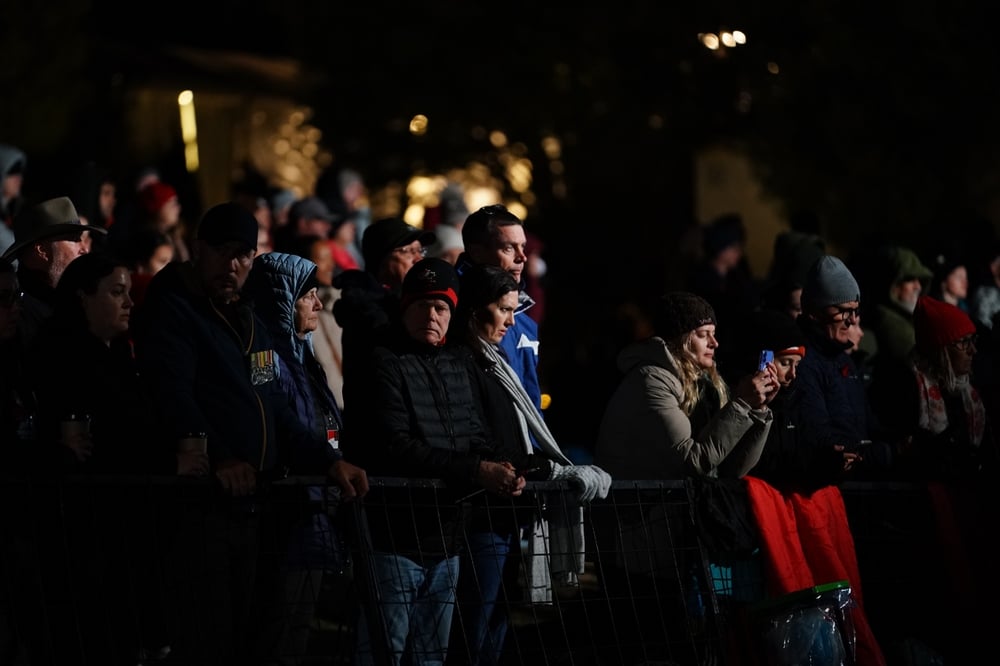
The image at the top of the page is of the Anzac Day dawn service and 110th anniversary of the Gallipoli landing, commemorated at Anzac Cove on the Gallipoli Peninsula